

page created: 3/6/00
updated: 5/25/06
| Anamorphic
vs. Non-Anamorphic DVD (2.35:1 Aspect Ratio Film) back to The Ultimate Guide to Anamorphic Widescreen DVD |
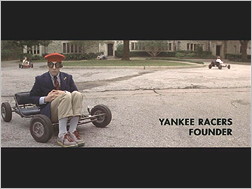
| The following is a comparison of anamorphic and non-anamorphic (letterboxed) widescreen DVD video, as displayed on Standard 4x3 and Digital 16x9 TVs. For this demonstration, we've chosen to use snapshots of actual DVD video from the film Rushmore (aspect ratio is 2.35:1). Buena Vista's original DVD version (on the left) is non-anamorphic. By contrast, The Criterion Collection DVD release (on the right) is anamorphic. |
| Non-Anamorphic (Letterboxed) | Anamorphic | |
|

|
|
| The
video recorded on a non-anamorphic DVD. Notice that the black bars
at the top and bottom of the frame are somewhat thicker than in a
1.85:1 presentation. Since the 2.35:1 aspect ratio is wider, the
thicker bars are necessary to maintain the proper composition. These
are actually present in the signal. |
The
video recorded on an anamorphic DVD. Notice that the image appears "squished"
horizontally, while retaining nearly its full vertical resolution.
In addition, black bars are now visible at the top and bottom of the
frame. Since the 2.35:1 aspect ratio is wider, the bars are
necessary to maintain the proper composition. These are actually
present in the signal. Normally, you would never see the video in
this state. The only time you would see this "squished"
picture, is if you were watching the disc on an improperly set-up
DVD player, using a Standard 4x3 TV - the player thinks you have a
Digital 16x9 TV. A quick adjustment in the player's menu would
correct this problem. |
|

|
|
|
| Non-anamorphic
video as it appears on a Standard 4x3 TV. This is the familiar
letterboxed image you're used to. |
Anamorphic
video as it appears on a Standard 4x3 TV. The DVD player performs a
mathematical downconversion on the video signal, in effect combining
every 4 lines of vertical resolution into 3 until the correct aspect
ratio is achieved. Electronically-generated black bars are added to
the existing ones (to fill in the remaining screen area), completing
the image. Visually, it's nearly indistinguishable from a
non-anamorphic (letterboxed) DVD image. |
|

|

|
|
| Non-anamorphic
video as it appears on a Digital 16x9 TV. The gray bars are
generated by the TV to fill in the remaining screen area. Using the
TV's "zoom" mode, you can magnify the image to fill the
screen electronically, but at the cost of degrading the image
quality significantly. |
Anamorphic
video as it appears on a Digital 16x9 TV. The "squished"
image recorded on the disc (seen at top) is sent directly to the TV,
which stretches the video signal horizontally until the correct
aspect ratio is achieved. As you can see, the image fills the frame,
while retaining nearly its full vertical resolution. Since the
2.35:1 aspect ratio is wider, thin black bars are still necessary to
maintain the proper composition (they're in the video signal). The
picture quality is stunning. |
|
back to The Ultimate Guide to Anamorphic Widescreen DVD |
||
 |
  |
Site
designed for 1024 x 768 resolution, using 16M colors and .gif 89a
animation. © 1997-2015 The Digital Bits, Inc., All Rights Reserved. billhunt@thedigitalbits.com |